totaalBED: set up first, then pick
At six in the morning, the pickers at totaalBED started on the orders so that every truck could load on time. Only when everything for the truck was ready did the replenishment of the pick locations begin. The warehouse day was built around one thing: the picking process. Ceyenne WMS turns that order upside down. And that turned out to be exactly what the team needed.
The challenge
Picking set the old rhythm of the warehouse. First all orders were staged for the trucks, and only then did the replenishment of the pick locations follow. Every morning that put a lot of pressure on the floor: everything has to go, nobody waits.
On top of that, the administration ran on pen and paper. Lists were filled in by hand and processed later. Everything took two steps: write it down, then process it again. Especially for goods that cannot be released straight away, the information depends on those lists.
The approach
Ceyenne WMS reversed that daily rhythm. Every day now starts the same way: first process the incoming goods, then the replenishment tasks, and only when that is done does the picking process begin. Because order picking is well automated, it has become the least labour-intensive part of the day. The warehouse can therefore start picking much later in the day, and the last orders of the day run along quietly.
This was not a matter of installing software and carrying on. The manager himself calls it a culture change: the technology was in order, but people had to organise their day around a different sequence.
On the floor this took a fixed shape in three ways
-
Scan everything
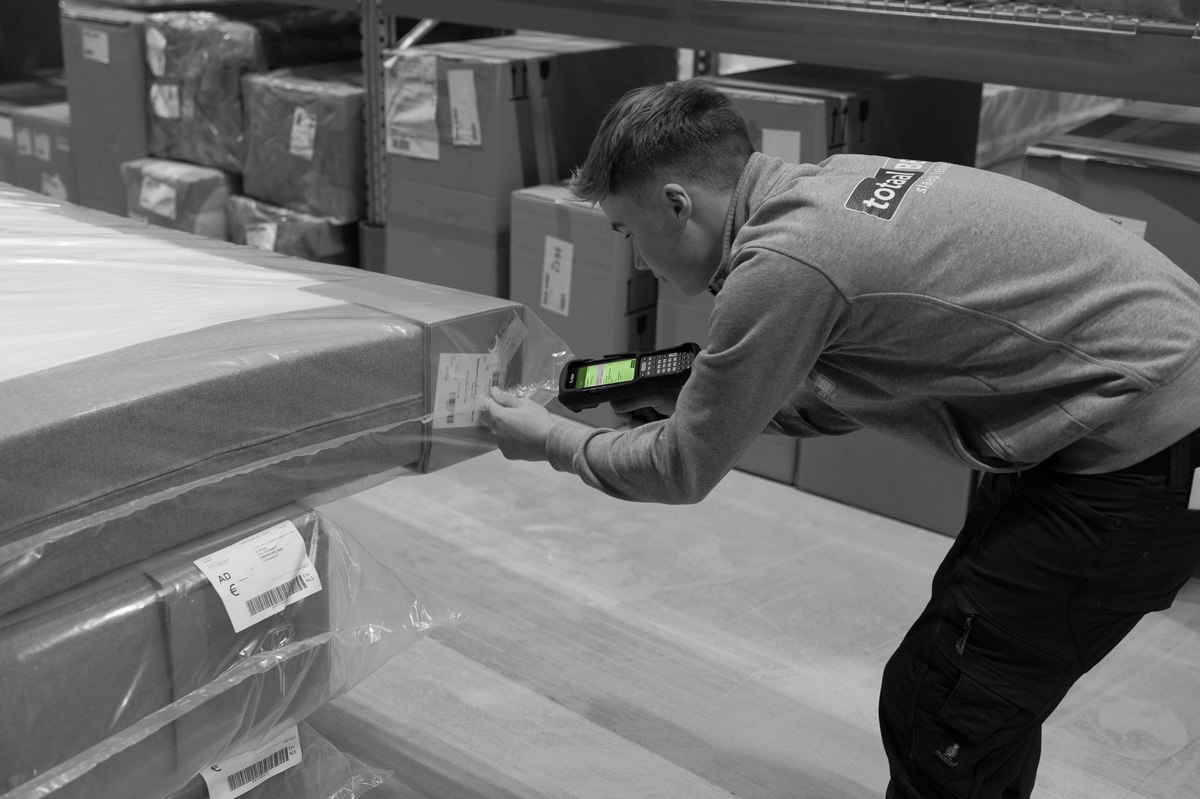
Pen and paper are gone. Tasks such as putting goods away now run through the barcode scanner, without writing anything down and processing it later.
-
Sticker on and done
Goods that have to be put on hold get a hold sticker right at goods receipt. All the required information is therefore in one place, instead of having to be gathered from lists afterwards.
"Now we can put a hold sticker on right at goods receipt, and then you already have everything together."
Warehouse employee, totaalBED -
Scanner leads, colleague guides
New team members get a scanner that guides them through the work. On quiet days a new colleague walks along behind an experienced employee, who gives feedback on what goes well and what could be better.
totaalBED also chose a striking order for the project: the WMS went live a year before the move. Where everyone expected the move itself to be the easy part, the reverse turned out to deliver a year of lessons.
"I am glad we did it before the move, because we have now worked with the WMS for a whole year in the building we know, with our current ways of working."
Warehouse manager, totaalBED
The team worked with the WMS for a year in the old building, learned from it, and together with Diract looked at the impact of all the stock movements and replenishments of that year. That analysis was included in the plan for the move, so that the new building could be laid out logically and the products landed on the right locations straight away. The way of working with Ceyenne WMS was also used to coordinate the move, so that employees could start with a logical process in the new warehouse.
The result
- Different order of the day. Inbound and replenishment first, only then picking. The pressure of the early start is gone.
- Thanks to automation, the picking process is now the least labour-intensive part.
- Taking the last orders of the day along is no longer a rush job but standard practice.
- Less paper. Pen and lists have been replaced by scanning. Time saved, as the employee puts it: "really saved a lot of time".
- Hold information right at the start of the process, captured with one sticker, instead of gathered afterwards.
- New colleagues are quickly productive. Explaining the scanner menu is enough to get started. Training is walking along on a quiet day, with feedback from an experienced colleague.
In the customer's words
-
This was really a culture change for our people, because at the start everyone felt the pressure.
-
But now we notice that the picking process, because we have automated everything well, is actually the least work of the whole process.
-
The new system is so handy. It really takes you by the hand.
-
We used to do everything with pen and paper. And yes, that has actually become easier for us now, because we scan everything with barcodes. And that has really saved us a lot of time.
The collaboration